
A negative review doesn't ruin your reputation — a bad reply does. Future customers read mostly how you react to criticism, not the criticism itself. A calm reply that takes ownership of the problem and offers a solution turns a bad review into proof of professionalism. Here's the four-step pattern, plus what you never do.
Why the reply matters more than the review
No one has only 5-star reviews — and a perfect profile with no criticism looks fake. What matters is the balance and how you handle a complaint in public. A potential customer who sees you reply professionally to a problem trusts you more than if there had been no negative review at all. On top of that, reviews and replies are a local SEO signal — real activity on your profile helps you rank higher.
The four-step pattern for a good reply
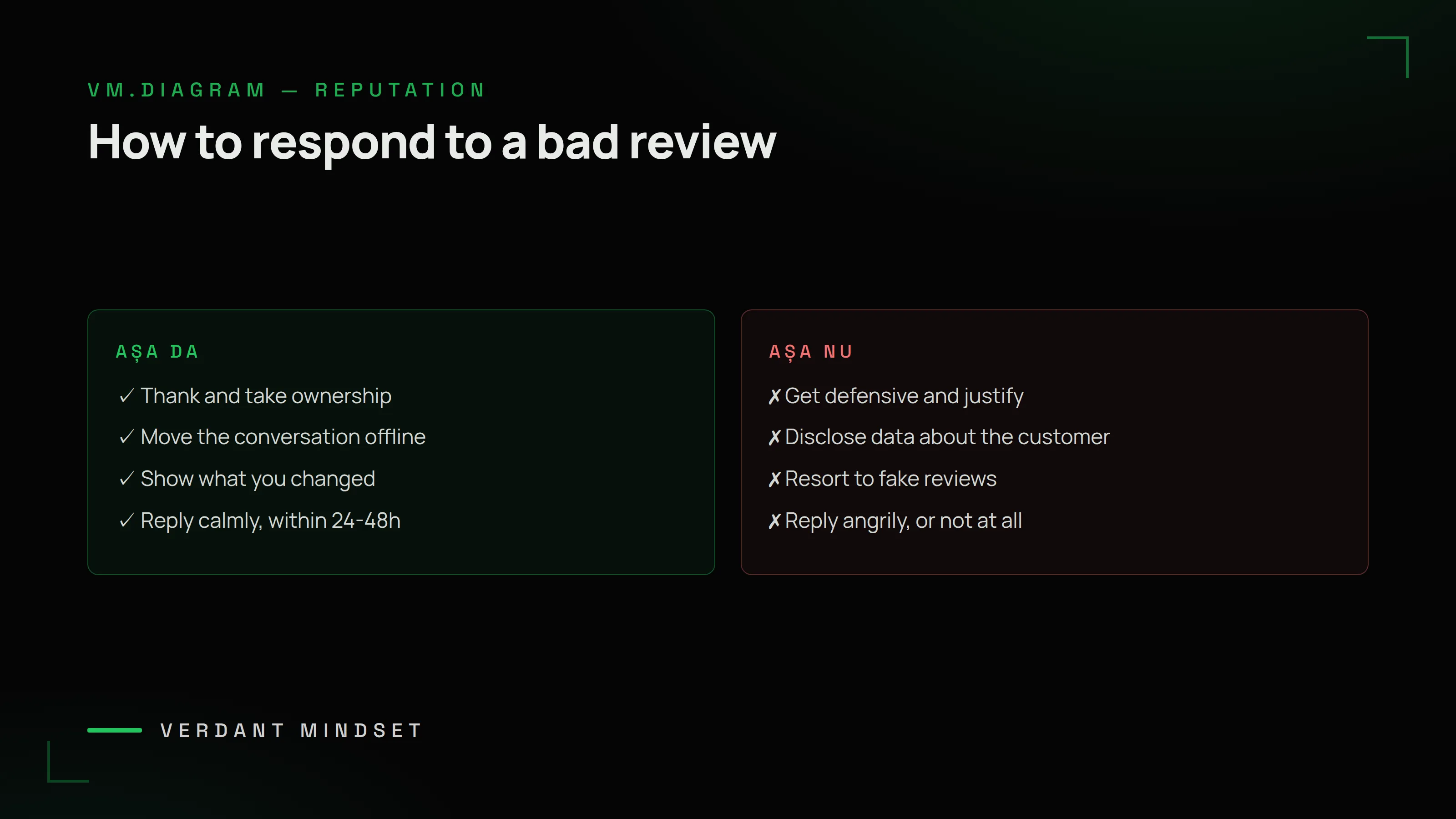
- Thank and take ownership. "Thank you for the feedback, I'm sorry the experience wasn't up to expectations." No defensiveness.
- Own it, without empty excuses. Acknowledge the valid point, without long justifications or blaming the customer.
- Move the conversation offline. Offer a direct channel (phone, email) to resolve it concretely — you publicly signal that you care, without arguing in full view.
- Show what you changed. If you fixed something, say so. Turn the criticism into proof that you improve.
What you never do
Don't justify aggressively, don't argue and don't be sarcastic. Don't disclose data about the customer — especially in a sensitive field (medical, legal), where it's also a confidentiality issue. And don't resort to fake reviews to "clean up" the profile: platforms detect them, and the risk (suspension, loss of trust) is far greater than the gain. Honesty is, here too, the strategy that lasts.
How to get more good reviews (to dilute a bad one)
The best defense against a bad review is a steady flow of real, good ones. You can ask — ethically — satisfied customers, at the right moment, through an automated flow: a short message after you deliver, with the direct link to the profile. You don't buy them, you don't condition them — you just make it easy for the happy customer to say what they felt. Good reviews are also a conversion engine: the social proof that makes the next person choose you.
FAQ.PROTOCOL
Frequently Asked Questions
Let's build something remarkable.
30-min discovery call — no cost, no pitch. We audit your digital architecture and deliver a clear operational plan.
- 01Short message with your business context
- 02Reply within 24h with a discovery-call proposal
- 03Operational plan + scope recommendation