
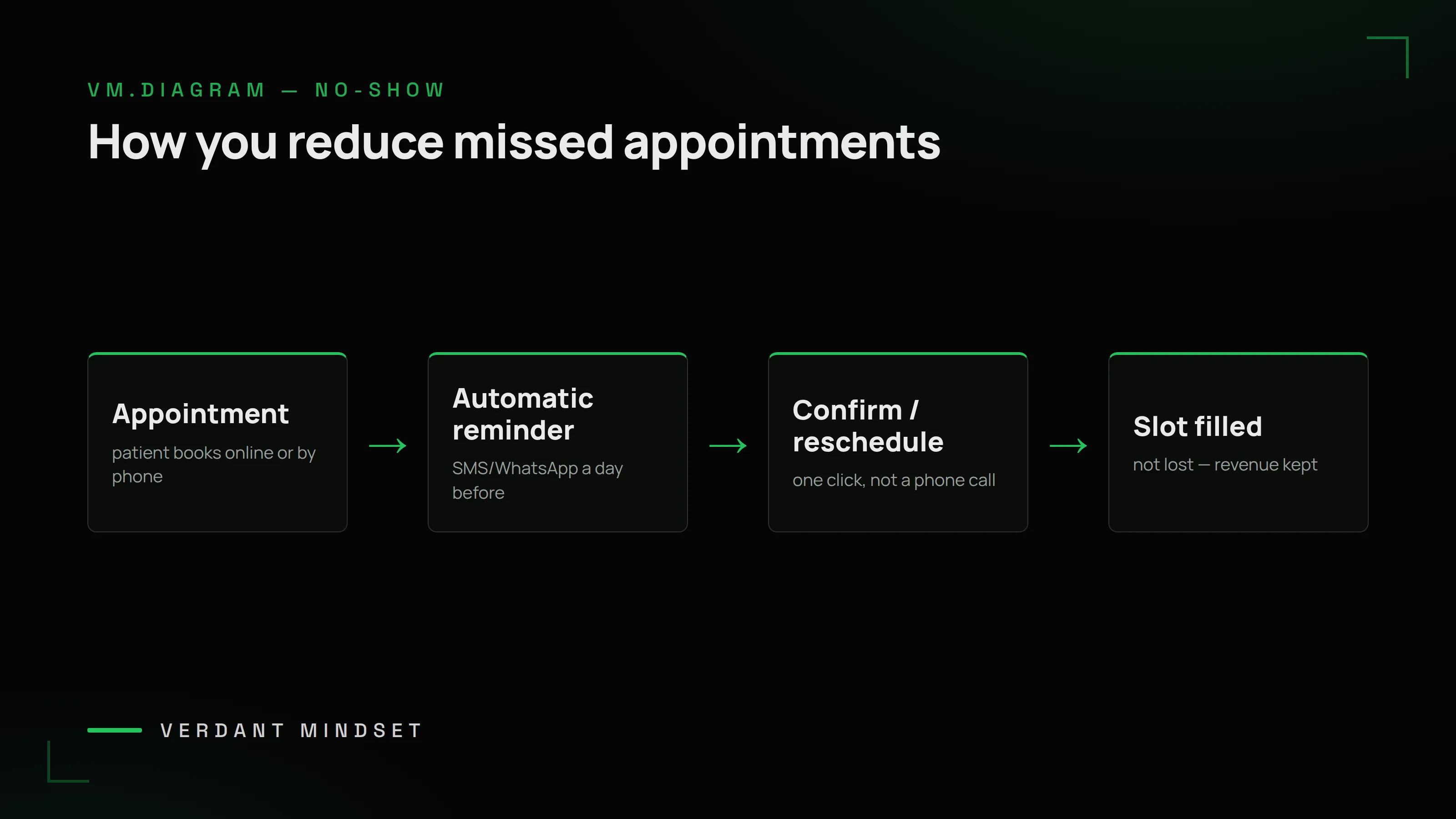
Every missed appointment is an empty slot that could have been another patient's — and lost revenue with no way back. You reduce them with automatic reminders (SMS or WhatsApp) that ask for confirmation and offer a one-click reschedule, plus online booking that puts the patient in control. Without putting someone at the front desk on the phone all day.
Why "we'll call to remind them" doesn't work
Calling manually is slow, gets forgotten and eats the front desk's time. At a high appointment volume, no one gets to call everyone — and the forgotten ones are exactly the ones who don't show. The solution isn't more work, but a system that runs itself: an automated reminder flow that sends the right message, at the right time, without depending on who's free at the desk.
What actually reduces no-shows
- An automatic reminder, with confirmation. A message a day (and possibly a few hours) before, asking the patient to confirm or reschedule. The simple act of confirming raises attendance.
- Easy rescheduling, not cancellation. If the patient can't come, you want them to reschedule, not vanish. A reschedule link turns an absence into a moved appointment — the slot stays filled.
- Online booking that puts the patient in control. When patients pick their own time, on a site with a booking system, they engage more and show up more. It's also a signal of seriousness that converts.
Correct on the data side too
Reminders by SMS or WhatsApp mean you process contact data — so you need consent and a clear policy, especially in a medical field. We set them up correctly, compliantly, so the system is both efficient and within the rules. See also how you appear correctly on Google as a clinic, so the reminders work on a healthy patient flow.
See what no-shows cost you
At an engineering audit we estimate together how much you lose monthly from missed appointments and what a reminder flow suited to your practice looks like — with concrete steps, not promises.
FAQ.PROTOCOL
Frequently Asked Questions
Let's build something remarkable.
30-min discovery call — no cost, no pitch. We audit your digital architecture and deliver a clear operational plan.
- 01Short message with your business context
- 02Reply within 24h with a discovery-call proposal
- 03Operational plan + scope recommendation